Moisture barriers · Bellevue, WA
A real moisture barrier under your Bellevue home
Thin, torn plastic doesn't stop ground moisture. We install a heavy vapor barrier, lapped and fastened, in Bellevue crawl spaces from Bridle Trails to Newport Hills.
- Old plastic: thickness, tears and gaps at the walls
- Standing water or mud on the uphill side
- Moisture staining on joists and sill plates

 Moisture barriers for Bellevue homes
Bellevue homes
Moisture barriers built around Bellevue houses
Many Bellevue crawl spaces still have the plastic that went down when the house was built, or a cheap replacement laid loose decades later. It's thin, it's torn where cable and plumbing crews crawled across it, and the edges have pulled back from the foundation walls. Ground moisture comes up through every gap. Between October and May the soil stays wet, and that vapor ends up in the floor framing and the insulation above. You see it as musty air on the lower floor, rusted nail tips, dark staining on joists, or batts hanging heavy with moisture. None of it is visible until someone opens the access hatch.
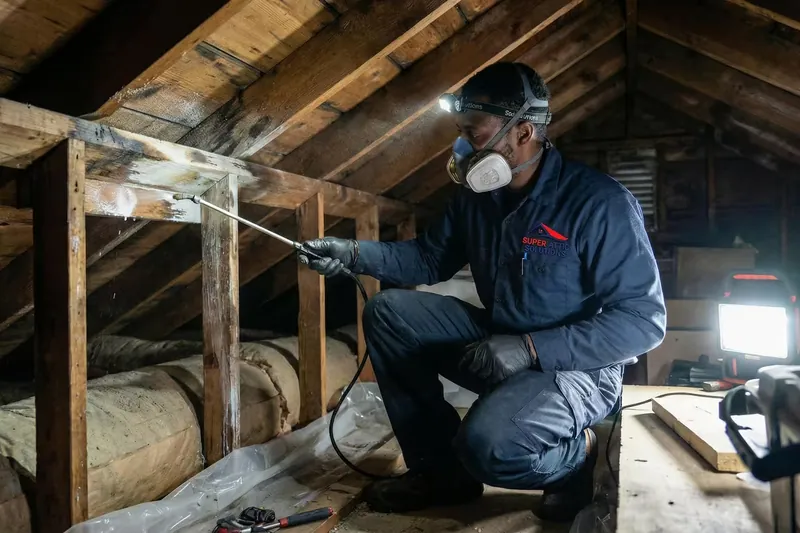
On the slopes of Somerset, Newport Hills and Factoria, a crawl space often sits below grade on the uphill side, so water runs toward it in long storms. A barrier alone won't fix pooling water, so we look at downspouts, grading and any standing water first and tell you what we see. Then we clear the ground, lay a heavier reinforced barrier with wide overlaps, tape the seams, and run it up the foundation walls and around piers. Where the space needs more, we can take it further into full encapsulation. Either way you get photos of the finished crawl space floor, edge to edge.
- Old plastic: thickness, tears and gaps at the walls
- Standing water or mud on the uphill side
- Moisture staining on joists and sill plates
- Downspouts and grading that send water to the foundation
Local conditions
What Bellevue throws at attics and crawl spaces
The houses
Most of Bellevue's single-family housing went up between the 1950s and the 1980s. Lake Hills, Crossroads and Eastgate are full of 1950s and 1960s ramblers and split-levels on vented crawl spaces, with low-pitch roofs and shallow attics. Newport Hills and Somerset added 1960s and 1970s split-levels and daylight basements stepped into sloped lots. Bridle Trails has larger custom homes on wooded acre lots. West Bellevue and Woodridge mix originals with big new rebuilds. Older attics often still hold the first layer of fiberglass batts, now thin and compressed, topped with whatever a later owner blew in.
The weather
Bellevue sits between Lake Washington and Lake Sammamish, and humidity stays high through the wet season from October to May. Mercer Slough and Kelsey Creek run through low ground where crawl spaces stay damp. Hillside neighborhoods like Somerset and Newport Hills take more wind in winter storms. Mature Douglas firs and cedars shade many roofs, holding moss and dropping needles that clog gutters and soffit screens.
The wildlife
Bellevue's greenbelts, creek corridors and parks give rodents cover close to houses. Roof rats run fence tops, overhead lines and fir branches to reach roofs, then slip in at roof returns and vent gaps. Norway rats burrow along Kelsey Creek and Mercer Slough and under decks and sheds. Mice move indoors each fall. Raccoons and squirrels test loose vent screens and soffits.
Typical results
What moisture barriers looks like

 BeforeAfter
How it works
Same crew, same standard, in Bellevue
- 01
Inspect inside and out
- 02
Trace each water source
- 03
Fix the barrier and the vents
- 04
Get roof water away
- 05
Recheck and photos
FAQ
Moisture barriers in Bellevue: FAQ
Still unsure? Call (800) 674-4933 and talk it through with us.
Is a vapor barrier required in Washington crawl spaces?
Washington's building code calls for a ground-cover vapor retarder in vented crawl spaces. Beyond code, it's the simplest way to keep soil moisture out of your floor framing. If yours is missing, torn or pulled away from the walls, it isn't doing that job, and replacing it is usually a straightforward project.
What's the difference between a moisture barrier and encapsulation?
A moisture barrier covers the ground to stop vapor rising from the soil. Encapsulation goes further: the liner runs up the walls and is sealed, vents are closed, and the space is managed as part of the house. A barrier is enough for many Bellevue crawl spaces. We recommend encapsulation only when the moisture load calls for it.
More in Bellevue
Other services here
Other cities
Moisture barriers nearby
Free moisture barriers inspection in Bellevue.
Book a free inspection. We'll photograph your attic and crawl space and walk you through what we find, before you decide anything.